
Truck & Rail Loading
The Vortex Loading Spout (also known as a loading chute) can be used in conjunction with accessories specifically designed to speed up the loading process in truck and rail applications.
Información general del producto
The Vortex Loading Spout (also known as a loading chute) can be used in conjunction with accessories specifically designed to speed up the loading process in truck and rail applications.
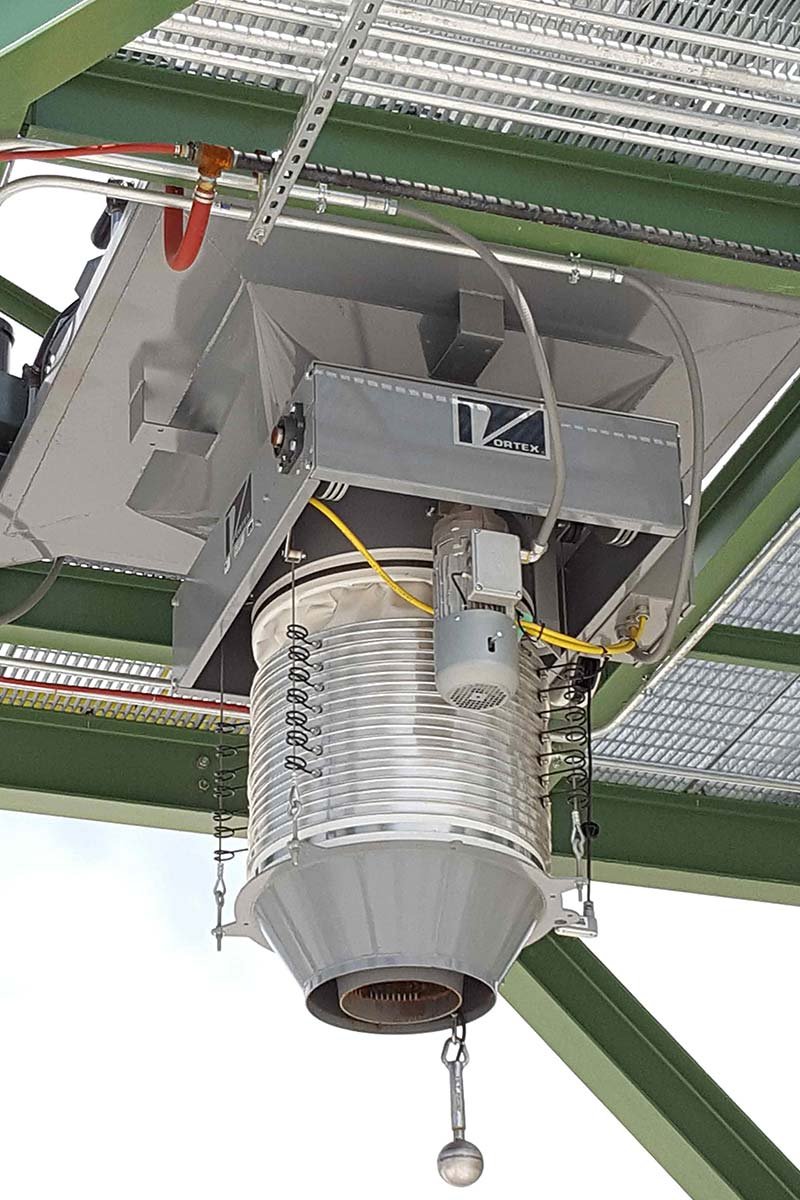
• 1. Vortex In-Line Filtration System at the material feed inlet to collect fugitive dust by means of air extraction. Fugitive dust is captured in pleated polyester filter cartridges. Throughout the loading process, automatic reverse pulse jets inject compressed air to purge the captured dust back into the load.
• 2. Single- and dual-axis positioners to move the spout laterally. Positioners save time by allowing trucks and railcars to pull up close to the loading station, rather than having to pull in and out of the loading station several times before properly positioning themselves beneath the spout. Instead, the spout’s position is quickly adjusted.
• 3. Outer sleeve to contain fugitive dust.
• 4. Stacking, cone-in-cone spout design.
• Open or enclosed loading capabilities.
• 5. For enclosed loading applications, the spout’s outlet scavenger “seats” into the hatch to prevent dust from escaping into the atmosphere. For loading slotted railcars or vehicles with non-standard hatches, optional hatch adapters can be easily removed and swapped out.
• For enclosed loading applications, an optional self-sealing discharge system seals off the outlet scavenger to prevent dust from escaping into the atmosphere between loading cycles.
• 7. For open-loading applications, a dust control skirt covers the top of the material pile to prevent dust from escaping into the atmosphere.
• Option to install a Vortex process gate above. When used in conjunction with a Vortex material flow control assembly, it allows for metering through the spout.
• Optional Aero-Bin Bottom. If a spout is mounted to a hopper or silo, an Aero-Bin Bottom can be installed between the hopper/silo and the spout. Its purpose is to fluidize a large area of material to facilitate flow.
1. Vortex In-Line Filtration System at the material feed inlet to collect fugitive dust by means of air extraction. Fugitive dust is captured in pleated polyester filter cartridges. Throughout the loading process, automatic reverse pulse jets inject compressed air to purge the captured dust back into the load.
2. Single- and dual-axis positioners to move the spout laterally. Positioners save time by allowing trucks and railcars to pull up close to the loading station, rather than having to pull in and out of the loading station several times before properly positioning themselves beneath the spout. Instead, the spout’s position is quickly adjusted.
3. Outer sleeve to contain fugitive dust.
4. Stacking, cone-in-cone spout design.
Open or enclosed loading capabilities.
5. For enclosed loading applications, the spout’s outlet scavenger “seats” into the hatch to prevent dust from escaping into the atmosphere. For loading slotted railcars or vehicles with non-standard hatches, optional hatch adapters can be easily removed and interchanged.
For enclosed loading applications, an optional self-sealing discharge system seals off the outlet scavenger to prevent dust from escaping into the atmosphere between loading cycles.
6. In open-loading applications, a material-level-sensing device works in conjunction with an auto-raise system to automate the retraction process for truck and rail loading. Throughout the loading process, the spout maintains its proximity between the discharge point (i.e., the outlet scavenger) and the material pile—even as the pile grows. Because of the outlet scavenger’s close proximity to the material pile, dust control is improved. The automated retraction process also prevents the outlet scavenger from becoming buried in the material pile, which in turn prevents material buildup in the spout. In enclosed loading applications, a material level-sensing device is synchronized with a process gate or belt conveyor above to automatically halt the flow once the specified load is reached. This automates the loading process to prevent vessel overfilling and eliminate the need for visual monitoring.
7. For open-loading applications, a dust control skirt covers the top of the material pile to prevent dust from escaping into the atmosphere.
Option to install a Vortex process gate above. When used in conjunction with a Vortex material flow control assembly, it allows for metering through the spout.
Optional Aero-Bin Bottom. If a spout is mounted to a hopper or silo, an Aero-Bin Bottom can be installed between the hopper/silo and the spout. Its purpose is to fluidize a large area of material to facilitate flow.
Open and/or enclosed loading applications
Gravity drop in the presence of slight negative pressure
250°F | 120°C for a standard spout, with modifications that allow for temperatures up to 400°F | 205°C
Overall height (when retracted) will vary depending on the model and application. Designed to be low-profile, taking into account the available overhead clearance and the extended travel required to reach the necessary vessel(s).
Standard options are available. Some Vortex Loading Spouts may require additional design considerations to ensure their successful performance in a given application.
Datos para evaluación técnica.
Aplicaciones
- 5. For enclosed loading applications
- The spout's outlet scavenger "fits" into the hatch to prevent dust from escaping into the atmosphere. For loading slotted railcars or vehicles with non-standard hatches
- Optional hatch adapters can be easily removed and swapped out.
- For enclosed loading applications
- An optional self-sealing discharge valve seals off the outlet scavenger to prevent dust from escaping into the atmosphere between loading cycles.
- 6. In open-loading applications
- A material level-sensing device complements an auto-raise system to automate the retraction of the truck &
- Rail Loading Types: Process. Throughout the loading process
- The spout maintains the distance between the discharge point (i.e., the outlet scavenger) and the material pile—even as the pile grows. Because the outlet scavenger is so close to the material pile
- Dust control is improved. The automated retraction process also prevents the outlet scavenger from becoming buried in the pile of material
- which, in turn, prevents material buildup in the spout. In enclosed loading applications
- A material level-sensing device is synchronized with a process gate or belt conveyor above it to automatically stop the flow once the specified load is reached. This automates the loading process to prevent overfilling of the vessel and eliminate the need for visual monitoring.
- 7. For open-loading applications
- A dust control skirt covers the top of the material pile to prevent dust from escaping into the atmosphere.
- Open and/or enclosed loading applications
- The overall height (when retracted) will vary
- Based on models and applications. Designed to be low-profile
- taking into account the available clearance overhead and the extended travel required to reach the necessary vessel(s).
- Standard options are available. Some Vortex Loading Spouts may require additional design considerations to ensure their successful performance in a given application.
También puede interesarle.
 Spanish
  English