
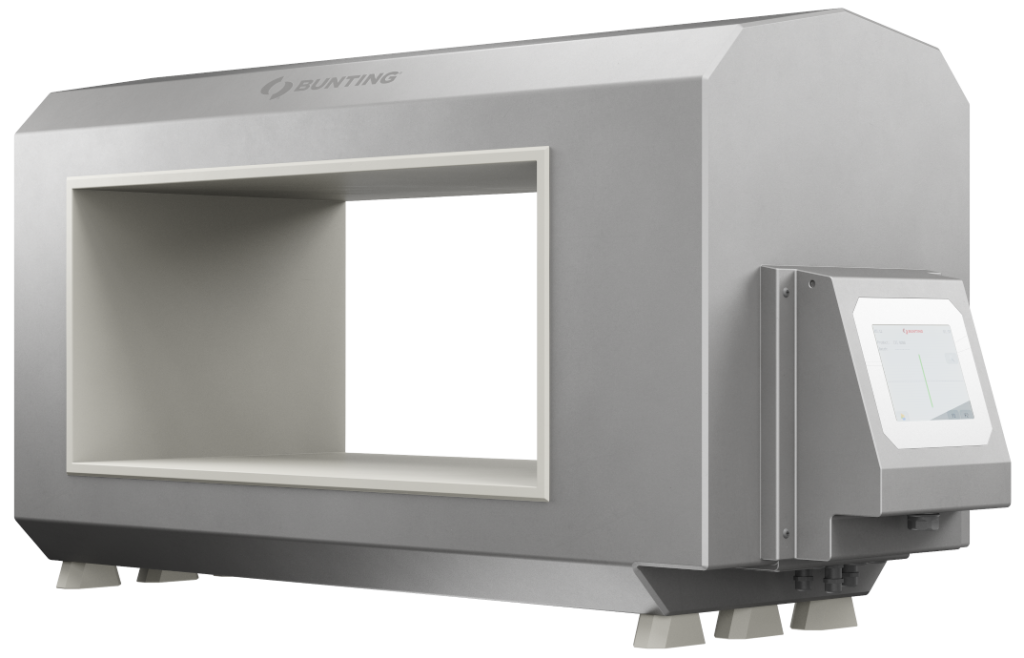
Tunnel-Style Metal Detectors for Conveyors
Tunnel Metal Detectors for food, plastics, and recycling. Detect ferrous, non-ferrous, and stainless steel contaminants to protect equipment and ensure compliance.
Información general del producto
Tunnel Metal Detectors for food, plastics, and recycling. Detect ferrous, non-ferrous, and stainless steel contaminants to protect equipment and ensure compliance.
• Metal Detection
• Tunnel Metal Detectors
• High-sensitivity detection of ferrous, non-ferrous, and stainless steel contaminants
• Hygienic one-piece design for easy cleaning and compatibility with washdown procedures
• Integrated system with digital signal processing for high-speed accuracy
• Supports compliance with HACCP, FSMA, FDA, USDA, and GFSI
• Seamless integration with pushers, diverters, or air-blast reject systems
• Low-maintenance operation with durable construction for 24/7 environments
• High-sensitivity detection of ferrous, non-ferrous, and stainless-steel contaminants
• The split-coil design allows for installation around existing conveyors without cutting the belt
• Ideal for retrofitting inspection capabilities.
• Compatible with reject systems and integrates easily into automation environments
• Corrosion-resistant construction options for washdown or industrial environments
• Supports regulatory compliance and quality assurance programs across industries
• Benefits
• Applications
• How They Work
• Food Processing & Packaging: baked goods, frozen meals, dairy products, meats, snacks, powders, grains, spices, and packaged ingredients.
• Plastics & Recycling: shredded plastics, pellets, granules, resins, bulk fibers, and recycled materials transported on non-metallic conveyors.
• General Manufacturing: bulk conveyed products and raw materials that require contamination-free inspection.
• Tunnel metal detectors consist of a coil (one-piece or split design) positioned around the conveyor or chute and a separate control unit housed in an enclosure.
• As material passes through the tunnel, the coil scans for metal contaminants. If metal is detected, the coil sends a signal to the control unit. The system processes the signal and triggers programmed actions such as stopping the conveyor, sounding an alarm, marking the product, or activating a rejection device.
• Designed for continuous inspection, they provide fast and accurate detection in high-throughput food, plastics, recycling, and manufacturing operations.
• One-piece tunnel detectors are designed for food safety. They feature a hygienic frame for easy cleaning and are compatible with washdown environments.
• Two-piece tunnel detectors are split-coil designs used in the plastics, recycling, and industrial sectors. They can be installed around existing conveyors without cutting the belt, making them ideal for retrofits.
Tunnel Metal Detectors are designed to provide highly sensitive detection of ferrous, non-ferrous, and stainless steel contaminants in a wide range of conveyed products. Available in both a one-piece tunnel style for food applications and a two-piece tunnel style for industrial applications, these detectors integrate easily into existing production lines to ensure product safety, equipment protection, and compliance with quality standards.
Applications: Food processing, packaging, and ingredient handling
Materials Handled: Packaged and unpackaged products, frozen foods, baked goods, bulk powders, grains, spices, dairy products, meats, and snacks
Applications: Plastics processing, recycling, and general manufacturing
Materials Handled: Shredded plastic, granules, pellets, bulk fiber, and products conveyed on non-metallic belts
Tunnel metal detectors provide continuous inspection of packaged and unpackaged products as they move along conveyors or chutes. They are designed to detect ferrous, non-ferrous, and stainless steel contaminants, protecting equipment, meeting quality standards, and ensuring consumer safety.
Available in one-piece tunnel designs for hygienic food processing and two-piece split coils for plastics, recycling, and industrial use, they integrate easily into both new and existing production lines. Their rugged construction and advanced digital controls ensure reliable performance in 24/7 operations.
High-Sensitivity Detection Identifies ferrous, non-ferrous, and stainless steel contaminants in both food and industrial products.
Hygienic or Industrial Designs: One-piece construction for food safety and washdown cleaning; split-coil versions for conveyors in the plastics and recycling industries.
Supports Compliance and Quality Standards; Helps meet HACCP, FSMA, FDA, USDA, GFSI, and industry-specific quality assurance requirements.
Seamless Integration Works with rejection systems such as pushers, diverters, or air-blast units, and connects to plant automation controls.
Retrofit-Friendly Options: Two-piece models can be installed around existing conveyors without cutting the belts, making them ideal for upgrades.
Low-Maintenance Operation: Durable construction and advanced electronics minimize the need for servicing, even in harsh environments.
Tunnel metal detectors are used in food safety, plastics, recycling, and industrial quality assurance:
Food Processing & Packaging: baked goods, frozen meals, dairy products, meats, snacks, powders, grains, spices, and packaged ingredients.
Plastics & Recycling: shredded plastics, pellets, granules, resins, bulk fibers, and recycled materials transported on non-metallic conveyors.
General Manufacturing: bulk conveyed products and raw materials that require contamination-free inspection.
These systems protect downstream equipment, reduce costly downtime, and help companies meet regulatory compliance and quality assurance standards across multiple industries.
A tunnel metal detector is a system that inspects products as they pass through a tunnel-shaped coil on a conveyor or chute. It detects ferrous, non-ferrous, and stainless steel contaminants in food, plastics, recycled materials, and industrial materials to protect equipment and ensure compliance.
Tunnel metal detectors are used in food processing and packaging, plastics manufacturing, recycling facilities, and general industrial production. They are essential for complying with food safety regulations, improving product quality, and protecting downstream equipment from foreign metal.
They inspect packaged and unpackaged food products, frozen meals, baked goods, powders, grains, spices, dairy products, meat, snacks, shredded plastics, pellets, granules, resins, and bulk fibers. Both food-grade and industrial tunnel detectors are available to suit the application.
Products pass through the tunnel coil while being transported on a conveyor or chute. If a metal contaminant is present, the detector coil generates a signal that is processed by the control unit. The system then activates alarms, stops the conveyor, or triggers a rejection device to remove the contaminated product.
One-piece tunnel detectors are designed for food safety. They feature a hygienic frame for easy cleaning and are compatible with washdown environments.
Two-piece tunnel detectors are split-coil designs used in the plastics, recycling, and industrial sectors. They can be installed around existing conveyors without cutting the belt, making them ideal for retrofits.
Yes. Food-grade tunnel detectors are designed to help processors comply with HACCP, FSMA, FDA, USDA, and GFSI requirements. They integrate easily with reject systems to ensure that contaminated products are removed from the production line before reaching consumers.
Yes. Tunnel detectors can be installed on new lines or retrofitted into existing conveyors. Two-piece split-coil designs are specifically engineered for easy integration without requiring the belt to be removed.
Yes. Food models are built with washdown-ready, hygienic stainless steel housings, while industrial models feature corrosion-resistant and dust-resistant construction, ensuring reliable operation in 24/7 environments such as recycling plants and plastics facilities.
Not sure what you need? Let's go over your application and figure out the right solution.
Datos para evaluación técnica.
Aplicaciones
- Tunnel metal detectors are designed to provide high-sensitivity detection of ferrous objects
- non-ferrous
- and stainless steel contaminants in a wide range of conveyed products. Available in both a one-piece tunnel style for food applications and a two-piece tunnel style for industrial applications
- These detectors integrate easily into existing production lines to ensure product safety
- equipment protection
- and compliance with quality standards.
- Applications: Food Processing
- packaging
- and ingredient handling
- Applications: Plastics Processing
- recycling
- and general manufacturing
- Supports Compliance &
- Quality Standards Help Meet HACCP Requirements
- FSMA
- FDA
- USDA
- GFSI
- and industry-specific quality assurance requirements.
- These systems protect downstream equipment
- reduces costly downtime
- and help companies meet regulatory compliance and quality assurance standards across multiple industries.
- They inspect packaged and unpackaged food products
- frozen meals
- baked goods
- powders
- grains
- spices
- dairy
- meat
- snacks
- shredded plastics
- pellets
- granules
- resins
- and bulk fibers. Both food-grade and industrial tunnel detectors are available to suit the application.
- Two-piece tunnel detectors are split-coil designs used in the plastics industry
- and industrial applications. They can be installed around existing conveyors without cutting the belt
- making them ideal for retrofits.
- Not sure what you need? Let's go over your application and figure out the right solution.
Especificaciones
- Detects:: Ferrous
- non-ferrous and stainless steel
- Applications: Food processing
- packaging
- plastics
- recycling
- bulk goods
- Integrated system with digital signal processing for high-speed accuracy
- As material passes through the tunnel
- The coil scans for metal contaminants. If metal is detected
- The coil sends a signal to the control unit. The system processes the signal and triggers programmed actions, such as stopping the conveyor.
- sounding the alarm
- marking the product
- or by activating a rejection device.
También puede interesarle.

 Spanish
 English